Richmonders
have taken pride and satisfaction at the volunteer work being done in our
historic African American cemeteries like Evergreen, East End, and
Woodlawn. Through the efforts of
determined volunteers, graves are being uncovered, restored, and cataloged
while revealing a vital facet of Richmond’s history that has been obscured
under leaves and kudzu for generations. The condition of local black cemeteries
has drawn national and international attention, and because of this, Richmond is
becoming an important destination for African American heritage tourism and
research.
Despite the
attention brought to these cemeteries, there are still Richmond graves that
remain undiscovered and unmarked. The tiny
cemetery at 9550 Evansway Lane once served a long-vanished nearby Baptist
church, but today is hemmed in by tri-levels.
No trace of who is in the cemetery remains. In City real estate records, the ownership of
the little plot is with members of the Laurus family, who once owned much of
the surrounding farmland.

9550
Evansway Lane, near Bon Air. This small
cemetery, with its nameless graves, is today wedged between suburban
homes.
The woods that
cover the half-acre property at 6911 Old Westham Road conceal a lost African American
Richmond cemetery. Now located between commercial buildings and suburban homes,
the cemetery serves as the dumping ground for the landscape debris from the
McDonald’s restaurant beside it. A small
creek forms the southern boundary, on the other side of which is an auto repair
shop. The yard of the house next door and
Old Westham Road complete the boundaries. Old Westham Road was the predecessor of today’s Cherokee Road, and connected
the community of Granite to the Westham Bridge, the nearest crossing going north
into Henrico County. What is now little
more than a shortcut between Cherokee and Forest Hill Avenue was once part of an
important north Chesterfield thoroughfare.

This 1920 map shows the path of Old Westham Road before a century of suburban development transformed the area by the 1950s. The Old Westham Road Cemetery is located just above the words “Bon Air” on this map, while today’s Stratford Hills Shopping Center is approximately where the words “J. W. Newton” are in the lower right corner.
The hamlet of
Granite gave its name to the little train stop and siding where the Richmond
and Danville railroad crossed the “River Road.”
The site is where today’s Forest Hill Avenue crosses the train tracks as
it passes above the Powhite Parkway. Rock cliffs visible on both sides of the toll
road at this point only hint at the industry here in James Netherwood’s
quarries that employed the men of Granite.
Nearby, another former operation owned by Netherwood is the site of
today’s Granite Recreation Association and Netherwood Road refers to his
family’s holdings and influence in the neighborhood.
Originally from
England, James Netherwood (1834-1899) supplied granite and supervised the
construction of the stonework on some of Richmond’s premier buildings and
monuments. His company shipped stone up
and down the east coast. Old City Hall (1894)
and the Masonic Temple on Broad Street (1893) were products of Netherwood’s
quarries and his masons’ work.
Netherwood erected many of the bases of the statues on Monument Avenue,
supervised the construction of the infamous railroad tunnel under Church Hill,
and the built the huge column that is the Confederate Soldiers and Sailors
Monument in Libby Hill Park in 1894. His
nephew, Albin Netherwood, continued the quarry business after his uncle’s
death.

A
map showing a portion of the Netherwood granite works. The “River Road” on the map is today’s Forest
Hill Avenue, and the Richmond and Danville Railroad still intersects that
street beside the Powhite Parkway and one of Netherwood’s water-filled
quarries.
As a village,
“Granite” was more than just a stop on the railroad that ran through the quarry
operations. The workers that pulled the stone from the soil of what was then
Chesterfield County lived along what is now Forest Hill Avenue, some as far
west as Sheila Lane, west of Chippenham Parkway. There were a series of small, frame cottages
all along this stretch of Forest Hill Avenue, of which only one remains at 6922
Forest Hill. This house appears unoccupied
and overgrown, and may soon be demolished and its site become another component
in the commercial area of Forest Hill. The fact the lot is assessed by the City at more than a quarter of a
million dollars and the house itself as only $1000 foretells the fate of the
last of the Granite workers’ housing on Forest Hill.

The
last of the frame bungalows that once lined Forest Hill
Avenue and housed many
of the quarry workers of the Granite community.
Edith Pride was
one of the residents of Granite, and her life can best be glimpsed in ten-year snapshots
by using the United States census, beginning in 1910. That year she is listed as a teenage member
of the household of James Netherwood’s nephew and heir, Albin, along with Albin’s
wife, five children and mother-in-law. Edith Pride was probably a young maid or
kitchen help for the Netherwoods.
By 1920, Edith
Pride is listed as a “candy packer” in the census that year, probably riding in
the back of a segregated streetcar every day to downtown Richmond where the
city’s small candy industry was mostly located in the blocks north of Broad
Street.
By 1930, she
described herself to the census taker as age thirty and a “laundress” with her
place of work a “private house,” which may have again been the Netherwood home.
She and her husband, Sterling were married in 1920, did not have children, and
lived in one of those now-vanished homes on Forest Hill Avenue among her
neighbors such as the Woolrich family, the Carringtons, and Colemans. She probably
made the walk daily down “River Road” to the Netherwood home and walked back up
the road in the evening with the dusty quarrymen, her neighbors.
The occupation
of Pride’s husband Sterling is listed in 1930 as simply “dentist,” but this
title does not do justice to his profession, training, or status. Sterling Pride was no ordinary tooth-puller
but instead appears in the Richmond City Directory as operating a “Dental
Laboratory” at 327 North 1st. Street. This was not an ordinary dental practice or
location, either. 327 North 1st
was in one of the (unfortunately now demolished) key Jackson Ward buildings
that figure in local African American history, having been designed by Charles
Russell, Richmond’s first black professional architect and where Russell had
his offices. It was also the home of the
St. Luke Penny Savings Bank – one of Maggie Walker’s several engines of black
enterprise and accomplishment.
Dr. Pride’s clientele
were members of Richmond’s African American society who were demanding services
once thought out of reach, such as their own architects, builders and bankers. This demand was fueled by the many men and women who worked in the banks and insurance companies in Richmond’s Jackson Ward where it was said to to constitute the greatest
concentration of black enterprise and talent between Washington and Atlanta. At the same time, black businesses like John
Mitchell, Jr.’s banking enterprise were moving out of the Victorian row houses
of Jackson Ward and into new buildings as the neighborhood grew and flourished. The fact that Sterling Pride had an office at
this address clearly signaled his was a well-trained and skilled dental
practice.
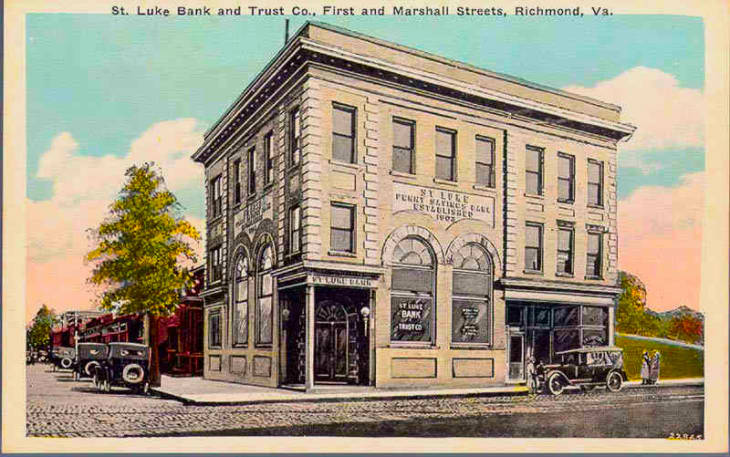
A postcard ca. 1920s showing the
building at 327-329 N. 1st Street that housed the offices of Charles
Russell, architect, his patron Maggie Walker’s St. Luke Penny Savings Bank, and
the dental laboratory of Sterling Pride.
Sterling Pride entered
Central State Hospital in Petersburg in early December 1955 and died there on
Christmas Eve. Central State was then a
segregated and chronically overcrowded mental hospital for “colored persons of
unsound mind.” Edith Pride died July 29,
1957, felled by a stroke that killed her within a couple of minutes, according
to her death certificate. Like many of
her contemporaries in Granite, her body was taken to the Mimms Funeral Home, at
1827 Hull Street, and prepared for burial.
The Mimms establishment is still serving South Richmond African-Americans
at that address as it has since 1925, and judging by the records, almost every
family in Granite called on Mr. Mimms’ services when a member died.
 The
temporary marker for Edith Pride was supposed to only last until a permanent
marker was installed. Instead, the
typewritten grave marker has lasted more than 60 years.
The
temporary marker for Edith Pride was supposed to only last until a permanent
marker was installed. Instead, the
typewritten grave marker has lasted more than 60 years.
When Edith
Pride joined her husband in the Old Westham Road cemetery, it was probably
clear of trees and debris and just another rural burying ground beside a shady
country road. She joined her neighbors,
her relatives, and her contemporaries in graves often marked by flat,
inexpensive stones held in a metal frame. A few are concrete, and some nameless graves seem to only have a piece
of unhewn granite to mark them. No doubt
some had wooden markers, now long gone. The depression in the forest floor beside Edith Pride’s marker is
probably the unmarked grave of her husband, Sterling.
Apparently forgotten,
Edith and Sterling Pride’s graves remain without permanent markers, with her
plot marked only by a piece of paper since the afternoon she was buried there in
1957. Nothing but oak leaves grace her grave, although little tributes of
plastic flowers decorate many of the marked burials in the cemetery. One grave decorated with flowers otherwise has
only a little scrap of metal that was the post for one of the funeral home
“courtesy markers,” indicating that even the temporary marker is long gone, but
somebody, somewhere, knew and once loved whoever is in the anonymous grave.

Some
friend or family member continues to bring flowers to this now anonymous grave
in the woods, marked only by the broken-off upright of a temporary marker.
When James
Netherwood died in 1899, he was buried in Richmond’s Oakwood Cemetery under a 20
foot tall monumental granite column of his own design. Netherwood constructed his monument years
before he was actually buried there, and it features a like-size statue of
Netherwood himself on top of the column, wearing his Masonic apron and other regalia. His nephew and Edith Pride’s employer, Albin
Netherwood, died in 1915, was buried in the Netherwood plot and his name was added
to the base of his uncle’s statue. Today,
the Netherwood monument that was designed to last a thousand years rises above
the small trees of Oakwood as a tribute to Richmond’s premier nineteenth-century
quarryman and stone contractor.

The
Netherwood monument in Oakwood Cemetery. The statue on the top is a self-portrait of James Netherwood, wearing his
ceremonial Masonic regalia.
The contrast
between James Netherwood’s grave and that of Edith Pride is breathtaking. You’d need a bulldozer and dynamite to completely
erase the massive Netherwood memorial from its site in Oakwood Cemetery. In comparison, the inscription of Edith
Pride’s marker was tapped out on a typewriter in a funeral home office sixty
years ago. As little as a careless
footfall or a broken tree limb could drive what little is left of Edith Pride’s
marker into the leaves, never to be seen again.
A comparison
between the two graves and how they are marked embodies classic Richmond contradictions
of rich and poor, black and white, permanence and fragility, the past and the
present. Both the neatly cut fields of
Oakwood and the shaded cemetery on Old Westham Road are heavy with memory, but only
in one cemetery does memory hang by such a thin thread.

Little
orange flags dot the woods of the cemetery on Old Westham Road. Their purpose is unknown, but if these
represent unmarked graves then quite a few people are buried in this plot.
Today, Old
Westham Road Cemetery is dotted with little orange flags on wire supports. The same method of marking has been observed
used in Evergreen Cemetery to show the location of otherwise unmarked graves,
so perhaps someone has taken an interest in the little plot on Forest Hill. Any change of use of the property would demand
the removal of the bodies – an expensive process for a site that is not hugely
desirable for either commercial or residential development.
So, for now the
woods keep their secrets and the seasons continue to blanket the unmarked
graves with another layer of oak leaves. With freezing and thawing, a bit more paper is lost from Edith Pride’s
grave marker as it over the decades gradually disappears. Aside from her Death Certificate and the Census record, this
typewritten scrap of paper is the last memory of her entire existence. As the seasons pass, it slowly returns to
pulp.
The Shockoe
Examiner will keep an eye on the Old Westham Road Cemetery and report any
developments.

- Selden Richardson.


